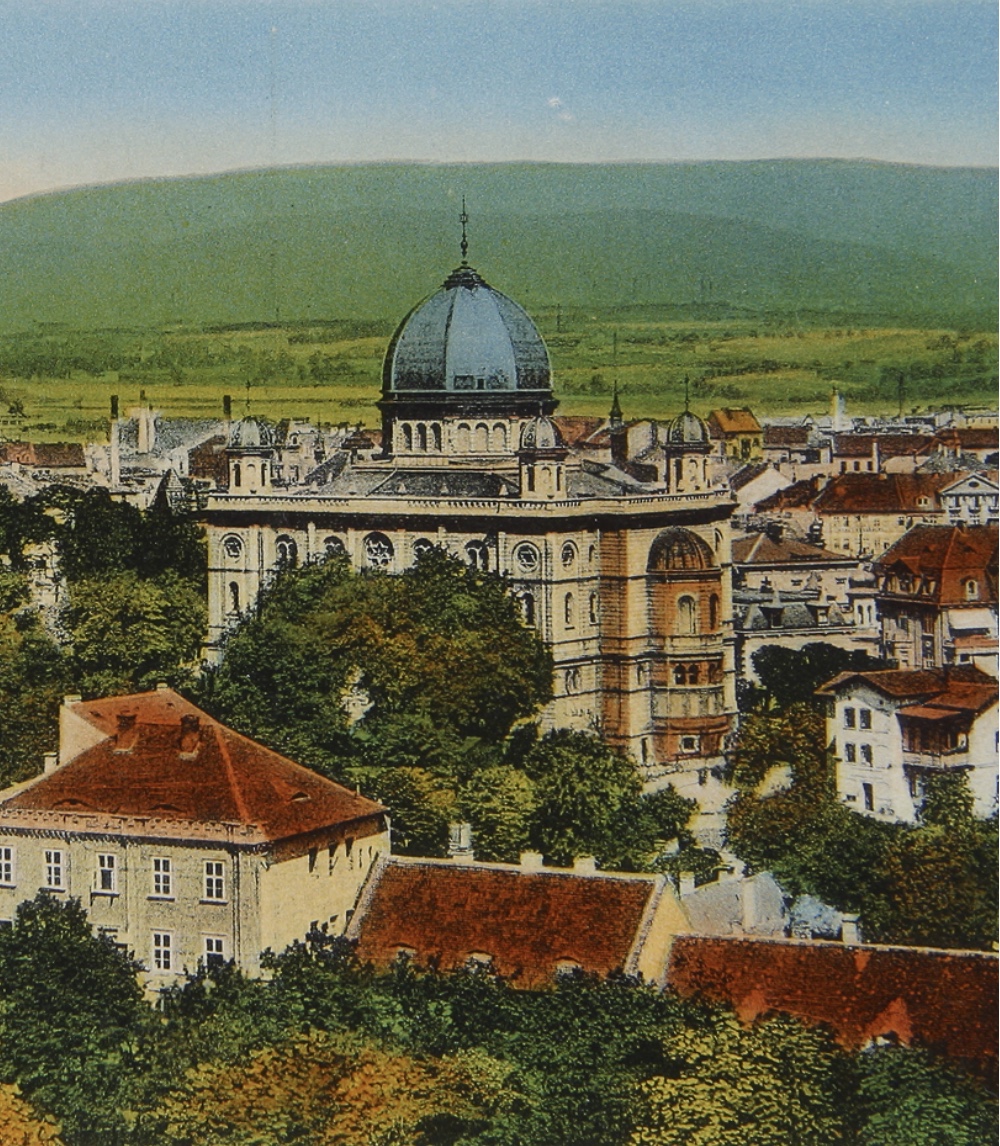
A spa town.
The location of the town is on a rocky spur below the Ore Mountains, the river Bilina runs through the town and a legend states that healing waters from local hot spring waters were discovered in the eighth century of the Common Era. The Romans established a settlement and in 1156 Queen Judith of Bohemia established a monastery nearby. In the middle ages, the town developed rapidly until the the Hussite wars in the 15th century, lead to the destruction of the monastery. At the end of 15th century, Doubravka castle was built on Doubravka hill. After Thirty Year war a German speaking population immigrated into the town. However, it always remained a popular spa centre. In 1712, Russian tzar Peter The Great visited Teplice and was enchanted by it. A great fire in 1793 led to the opportunity for many new opulent buildings. The golden age of Teplice was in the 19th C when it was known as a little Paris.
The earliest records of Jewish settlement was 1414 and by 1600, 29 Jewish families were recorded. A ghetto developed to the South East of the main town square in the 16thC and grew to over 50 houses on 3 streets by the mid 19thC. From the mid 19thC a Reform Synagogue was established, but in the early 1900s and influx of Orthodox from further East led to the building of a synagogue in 1925. Most of the ghetto and associated buildings were destroyed by the Nazis in WWII. A small Jewish community was revived after WWII with up to 200 congregants. There are three Jewish cemeteries in and around the town.
The descendants of two of Rachel’s children ended up living in Teplice at the beginning of the 20th Century. Alois, one of Rabbi Isak’s younger sons ran a grocery shop in the town and his son Robert was born there. His first wife Sofie and daughter Elsa died there from the terrible Influenza epidemic in 1916 to 1918.
Alzbeta eventually moved to Teplice at some point after her husband Jakob died in 1870 and at least three of her children also moved there, including Moritz, her oldest son, Abraham, Theresia and possibly another daughter Regina. Alzbeta, Moritz, Abraham and Theresia are all buried in the main Jewish cemetery.
The town is also the birth place of Shlomo Kidron, who in his biography gave a vivid description of Teplice
“As lying in a valley between the Erzgebirge mountains, along the north-western border of the Czech Republic and the Mittelegebrige mountains, a shorter and lower mountain range. This valley is rich with coal. The city has thermal baths and is knows as a health resort for those suffering from rheumatism and such like. In the early twentieth century, the city lost some of its grandeur and the number of visitors seeking healing did not exceed a few thousands per year. But at the beginning of the nineteenth century, people would have come from afar to find cures and peace. Among its visitors then were the grand members of society, princes and dukes, intellectuals, members of high society and artists. Goethe and Beethoven met there in 1812. He described the following story as being well-known “Beethoven and Goethe walked arm-in-arm in the garden of the palace when the Imperial entourage approached them. Goethe freed his arm from Beethoven, moved to stand by the path and bowed down. Beethoven folded his arms behind his back, walked in the middle of the path and the entourage parted to let him pass through. The prince greeted him first.”
The city, whose population in the 1930s was not more than 40,000, and with its surrounding suburbs, including the town of Turn, had a population of perhaps 60,000 or 70,000, bathed in greenery. One could cross the city from the palace garden with its two lakes, via the municipal park, the park named after the poet Seume (Seumepark) and all the way to Schoenaupark, without hardly crossing a road. It had thriving sport and cultural events, greater in number and impact than the size of the city would suggest. It had an indoor swimming pool with heated water which operated also in winter, a modern swimming pool with a diving board 10m high, where sport and entertainment events took place in summer. There were several well-kept tennis courts, and a football team which in the ‘20s and ‘30s was in the top league in the country. There were several cinemas as well as a municipal theatre which was disproportionally big for this city. The building’s façade was impressive as was the great hall of 1200 seats for opera and operetta, a small hall of 800 seats for theatre plays, a cinema, a café with a wide terrace adjacent to the municipal park, a nightclub and a beer cellar. Shlomo wondered how the city could support such a building, and especially the Opera House which included an orchestra, a choir, a ballet troupe and, of course, soloist singers, all of a provincial but impressive level. There was also a municipal orchestra which during the summer would play in the afternoons in the municipal park, a kind of promenade orchestra. In the city, whose inhabitants, like in all of the Sudetenland, spoke German, there were primary schools (nine years of school were obligatory) run in German and in Czech, there was also a Jewish primary school with five primary year, a gymnasium with eight classes, a vocational high school of seven classes, a school of commerce and an academy for commerce, as well as a Lyceum for girls which closed down in the 1930s. The language of instruction in all these schools was German. In Teplice there were about 5000 Jews. After Prague, this was the biggest Jewish community in the west of Czechoslovakia (Bohemia and Moravia). It was a Jewry in a western style – central European, of German language and culture, or perhaps more accurately Austro-Czech. As you know, until World War I, the Czech Republic was part of the Austro-Hungarian Empire, the Habsburg Empire. In the city there was also a small group of several hundred Jews of Eastern-European descent, and although they tried to look ‘western’ in their clothes and choice of language, they were a separate social group and the more assimilated Jews looked down at them, as the Ostjuden. Most of them were observant and they prayed in the small Orthodox synagogue in the old Jewish quarter, that a century before was the ghetto. For Shlomo and his family, the ‘western’ Jews, there was a liberal synagogue, a big and magnificent building which could seat about 3000 people, had two women’s galleries which were opened only for the holydays. On weekdays and on Shabbat, the women used to sit to the left and the men to the right, in the main hall. There was a platform for a choir and a big organ. This magnificent synagogue was burnt to the ground by the Nazis on Kristallnacht, in November 1938. Shlomo remembered the festive prayers on the holydays and on Friday nights with the organ and choir and a cantor with a brilliant tenor voice who held the title of Oberkantor. It was said that he applied for his post as a cantor with a picture of him as an opera singer in the role of Lohengrin by Richard Wagner (but this was before the Nazi era). Aside from the two synagogues, there were in the city of course also churches, two catholic churches and one protestant. Two or three times a day the church bells would ring and be heard throughout the city. Traffic in the 1930s was not yet busy or noisy as it is today. There was a bus company who took passengers from the main square in the city centre – the market square – to various destinations, but transport within the city was limited to the tram which crossed the city and went all the way to the resort area Eichwald (today ‘Dubi’) on the foot of the Erzgebirge. This is a picturesque region with forests, rivulets, little clean houses, and a big sanatorium for TB patients. Today the motorway from Berlin to Prague crosses Dubi to Teplice.
To get further afield, the train was used. The train line that crossed the north-west of the country passed through the city. Although it was rather small, Teplice had the air of a big city, not just for its culture but also its commerce. The coal mines in Sudetenland led to the development of varied industry in the region and accompanying busy commerce. The shoemaker Bata built in the city the very first building made of glass and one of the first department stores to open outside of Prague, by the name of Jepa, was in Teplice. “
