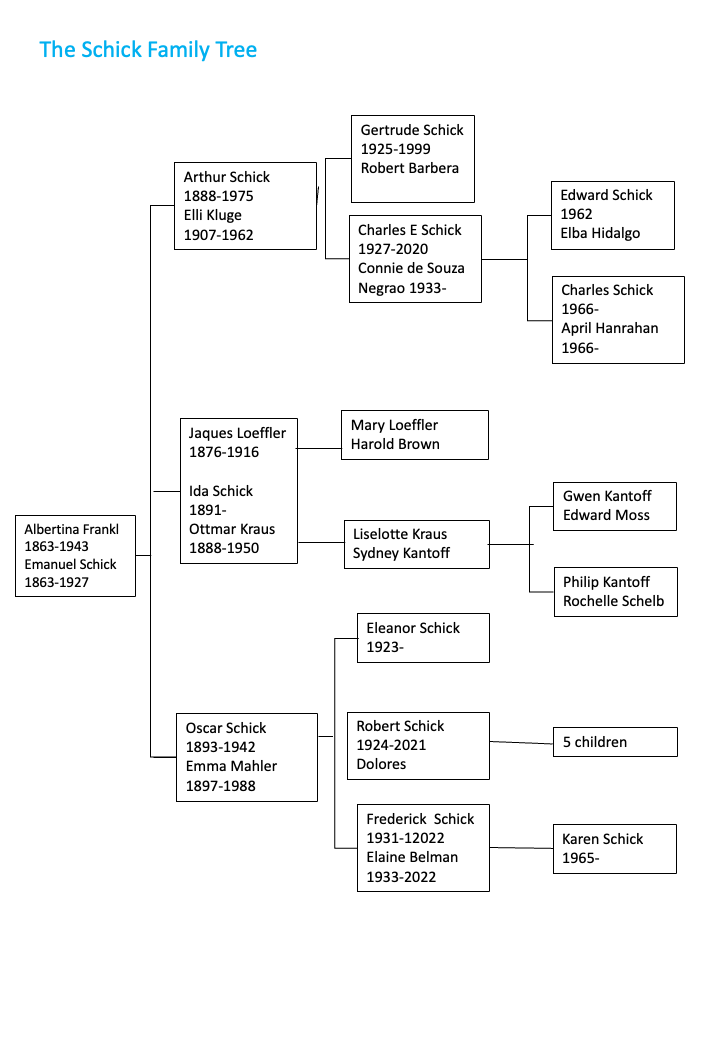
Arthur was born in the Bohemian town of Litoměřice in August 1888. His parents were Emanuel Schick and Albertina Frankl. His mother’s nickname within her very close-knit family was Tini. Emanuel ran a haberdashery store which sold everything associated with women’s clothing. A number of Arthur’s uncles lived nearby and ran a variety of stores in Litoměřice and other towns. His sister Ida was born in 1891 and brother Oscar in 1893.
Arthur had a very good memory and in his letters to his son Charlie described many incidents from his childhood. He described the scary and creaky climb of the very dark tower of the town church and reaching the room where the tower keeper lived. Every hour he used to go out on to parapet and blew his horn on all four sides. There were 3 bells hanging inside the tower, and one of them, the big one, was terribly loud and it was very scary if it began to ring when we were halfway up the tower. The old man was always happy when he had visitors, he never climbed down again because of his gout and even died upstairs in his room. After he died, a new younger man was recruited, but he was rough and unfriendly and we never went up there again.
His mother was very musical and used to sing a great deal. Although he was given a violin to play when he was five, his greatest talents was being able to draw very accurate copies of town posters.
The garrison town of Terezin was situated on the other side of the river to Litoměřice. When the soldiers marched through the town, they were accompanied by bands, and Arthur loved to follow the marching musicians.
When he was seven years old, the River Elbe flooded and while everyone was out, Arthur went for a wander to Goose Hill where there was a fairground with shooting galleries, carousels etc. well above the Elbe, so the flood water couldn’t reach it. The fairground gypsies were friendly and he really enjoyed sitting on the wooden horse. He didn’t need any money because rides could be earned. Helping to push the carousel ten times in a row earned one free ride. He worked very hard all afternoon and fell asleep on some straw. He fell so fast asleep that the gypsies couldn’t wake him, so they carefully and kindly covered him with a blanket and let him sleep there all night.
However, at home, there was panic. The whole town was alarmed, no one thought about Goose Hill, just the flood, and everyone was convinced that little Arthur had drowned. The police fished for his body with poles and hooks, without success…
Eventually Arthur woke up and wanted to go home, because was ravenous. He walked home, but the apartment was empty because everyone was out looking for him.
At home, he looked out of a window overlooking the street and saw Uncle Mannie standing on the street. So he shouted loudly: “Uncle”!
Uncle came racing up and then shouted out “Here’s the boy” gave him a great big hug and followed up with a huge smack! Everyone knew within five minutes that he had been found. Then father came because he could run faster than mother. First a hug, but then thrashing, spanking No.2. Then mother came. Same reaction, first kisses through tears, and thrashing No.3, Arthur said he couldn’t sit comfortably for weeks.
In 1897, his father’s business failed and Emanuel decided to move to the much larger town of Plsen and open a shop making and selling men’s trousers. It went very well and he soon moved to a new larger shop at the corner of the market square selling all aspects of men’s clothing. He then added pre-made children’s clothes from Vienna. The business was very successful and Emanuel became wealthy. By 1903 he had bought a house and a car. He did not have a good relationship with Albertina or Arthur, but completely doted on his beautiful daughter Ida. He bought a baby grand piano for Ida, on which Arthur taught himself to play. He sent Ida to Paris for a year to stay with his mother’s sister Anna who was married to Emile Dubsky. When Arthur was in secondary school he had violin and music lessons from a military musician.
Every day after lunch, father went to the café to play billiards with his friends, while mother went down to the shop. At 3 p.m. father came home to the shop and mother went up to the house where she had a helper, a maid for heavy work. There was a salesman named Wenzel in the shop all day without a break, who was paid miserably, as was common practice at the time. He only had one hobby, cycling. In the evening there was supper, then the shop was locked and father went to the other café with his friends.
When Arthur turned fourteen he discovered girls, starting with one of the kitchen servants. He used to go to dances where the local girls would gather. Daughters of the Jewish families were definitely off limit.
After secondary school, when he reached 16 years old, he was sent to a technical school in Prague to study civil engineering. Life in Prague was not quite so much fun, as his father was not generous with his allowance and it just about covered the cost of his accommodation and basic food requirements. Although his father did visit friends in Prague every couple of months to play cards and indulge in a more social life!
His father doted on Ida and was not very interested in the progress of either Arthur or Oscar. He sent Ida to Paris to stay with their uncle and was very generous in paying for visits to the opera and best fashion houses.
In 1906, Arthur was required to spend a year in the Plsen Infantry Regiment. After a tough year, he emerged from officer school with the rank of ‘Ensign’.
He went back to Prague to continue his studies and worked hard until a friend of his was caught up in a duel over a woman in which he lost an eye. Arthur was so upset by this that he challenged the other man to another duel under different conditions. Arthur was so angry that he badly hurt the other man who ended up in hospital for more than two months. Arthur had to run away from Prague for the rest of that school year. He returned for the fourth year, but by then was more interested in architecture. He was not able to complete his studies as an architect, but did complete his civil engineering exams and was able to adopt the title of “Engineer.”
Back in Plsen, Arthur enjoyed being close to his mother. However, his father’s business was in danger. A rival company set up opposite their shop and hired his father’s salesman, Wenzel to run it. This business became more successful and at the same time, the tax authorities came chasing for unpaid taxes. His father had to leave Plsen in a hurry and moved to Vienna in 1910. He also arranged a marriage to a very inappropriate man for Ida, her new husband Jacques Loffler was twenty years older than Ida and quite ugly. They eventually had one child, Mary, and then this unpleasant man died three years after the wedding in 1914. Ida was conned out of her inheritance.
Arthur was called back into the army in Plsen and eventually his regiment were transported to Serbia where he was severely shot and bayoneted.
He went back to Plsen where his mother still had an apartment and slowly recovered with her love and attention. He also continued to develop his musical talents, learning and playing with local musicians. He taught himself to play the piano, violin, accordion, banjo, and guitar. One of his strengths was his ability to speak various languages. He spoke and read German, Czech, French, Dutch, Hungarian, Italian, Swiss. Arthur also loved to paint and during this period he learnt to cook.
He ended up in Berlin in the early 1920s. His friends used to call him “Maurice” because he looked like Maurice Chevalier and played his songs and spoke French. Later they called him Charlie because that was a popular name in those days, and that’s why he called his son Charlie.
He became an iterant musician and ended up playing with a band in Berlin. On one occasion they were playing in a film studio alongside a troupe of ballet dancers. He met and fell in love with one of the dancers. Elsa (Elli) Kluge who had been born on May 8, 1907 in Chemnitz, Bavaria, southern Germany. Her great passion soon became ballet. She had talent and an aptitude for ballet eventually won a place at a ballet school in Berlin where she joined a dance group and that performed in film studios as part of movie making.
Gertrude (Trude) their first child was born on 26th January 1925 and Charlie followed two years later on 6th October 1927. They lived with Elli’s parents in Berlin.
Charlie’s health was not good and so they moved to different places, eventually managing to get to the USA before WWII started. The rest of their story is told by Charlie.
